

I have used my logging app since the 17th of August. Six weeks of baseline data by the 1st of October. Could be more, but it is definitely not a bad start. I am not Bryan Johnson after all.
I will now run you through the protocol for this experiment.
The logging app
Besides the coherence data, I also gathered my other baseline stats. All of these are logged in the app I mentioned in the publication, My tools. This also describes the different tools I use to provide the data.
Let me start with a word on the logging app and what it contains exactly. The first version is now finalised and will not be changed throughout the experiment. Excluding of course aesthetics if something were to really bother me. I can also no longer adapt previous days, except for an afterthought that will be timestamped.
The application contains the following sections, in order, followed by a brief description.
Morning:
This section contains a subjective part where I rate my sleep and feeling (spoilers: it is usually not that good, I am not good at waking up, remember?). It covers sleep quality, energy, mood and stress. The rest of that objective data comes from my Circular Ring, except for blood pressure. It also tracks whether I have a transcendental meditation session or not.
Baseline:
The data from my baseline session goes here. The section contains the time of day, average coherence score and mean heart rate. This input comes from the emWave pro.
S1:
The first coherence session of the day, straight after the baseline session. The time of day is noted, just like the protocol I use (emWave, ring or free pacer), the average coherence score and the breath pacer setting. Subjectively it asks whether I felt the shift after the session.
Sports:
Basic information about my sports sessions is tracked here, my Garmin does the rest. I note the type of session, the Rating of Perceived Exertion (RPE), training time and time of day.
Midday:
A subjective section where I write down the time of day, my energy, stress, mood and focus.
Evening:
Energy, stress and mood come back and then a summary of the day. Where I will sleep (home, Sweden, away), what kind of day it was (work, renovation, business or quiet) and life load (light, normal or heavy). Whether I did any breathwork outside of the protocol and, if so, for how long. And finally it keeps track of alcohol consumption, caffeine after 1400 and if anything else was off.
S2:
The exact same as S1.
Every section also has a “free text” part for any remarks.
The preparation
The experiment will start in October, but with the baseline data I needed, it has already been running since August. Without this data I would have nothing to compare against. So what did this preparation look like?
The logging app:
I just described the logging app; now I will tell you how I have used it so far. The section names already give it away a little, but morning could be anywhere from waking up to around 1300. At least for me.
When do I do the logging?
Morning: The subjective part is filled in right after waking up. When I still feel awful from a good night’s rest. The data from my ring and my blood pressure is filled in right after I have done my baseline session.
Baseline: The baseline session is logged right after it has been recorded.
S1: No coherence session done yet, but I will log them straight after recording.
Sports: No specific time to log this one. I do it the same day when I think about it.
Midday: The midday section is logged around 1200 before lunch.
Evening: The evening section is logged around 2100, after dinner.
S2: Same as S1.
The emWave pro app:
To measure my baseline coherence I use the emWave pro app every morning for five minutes after waking up, drinking some water, having a pee and finally weighing myself.
What does a baseline session look like?
First I plug in the USB module and attach the sensor to my ear. I start a session just to see if it actually starts recording. Otherwise I might have to clean the sensor or check the connection. I make sure the lights on the USB module are not visible and the audio feedback is off. Then I start the (five minute) session, turn on a neutral screensaver and set a timer for five minutes. I sit still behind my laptop in a neutral position, both feet on the ground and try not to focus on anything in particular, especially not my breathing. When the five minutes are over, I remove the sensor and log the session.
Except for testing, I do not run any other emWave sessions. The coherence training starts in October, so I will not be messing around with it before that time.
Below you can find the outcome of my baseline practice up until now. The graph shows my primary outcomes which I will expand upon a bit further ahead. I started using the app on the 17th of August. The 24th of August was the first day I started logging my baseline coherence sessions.
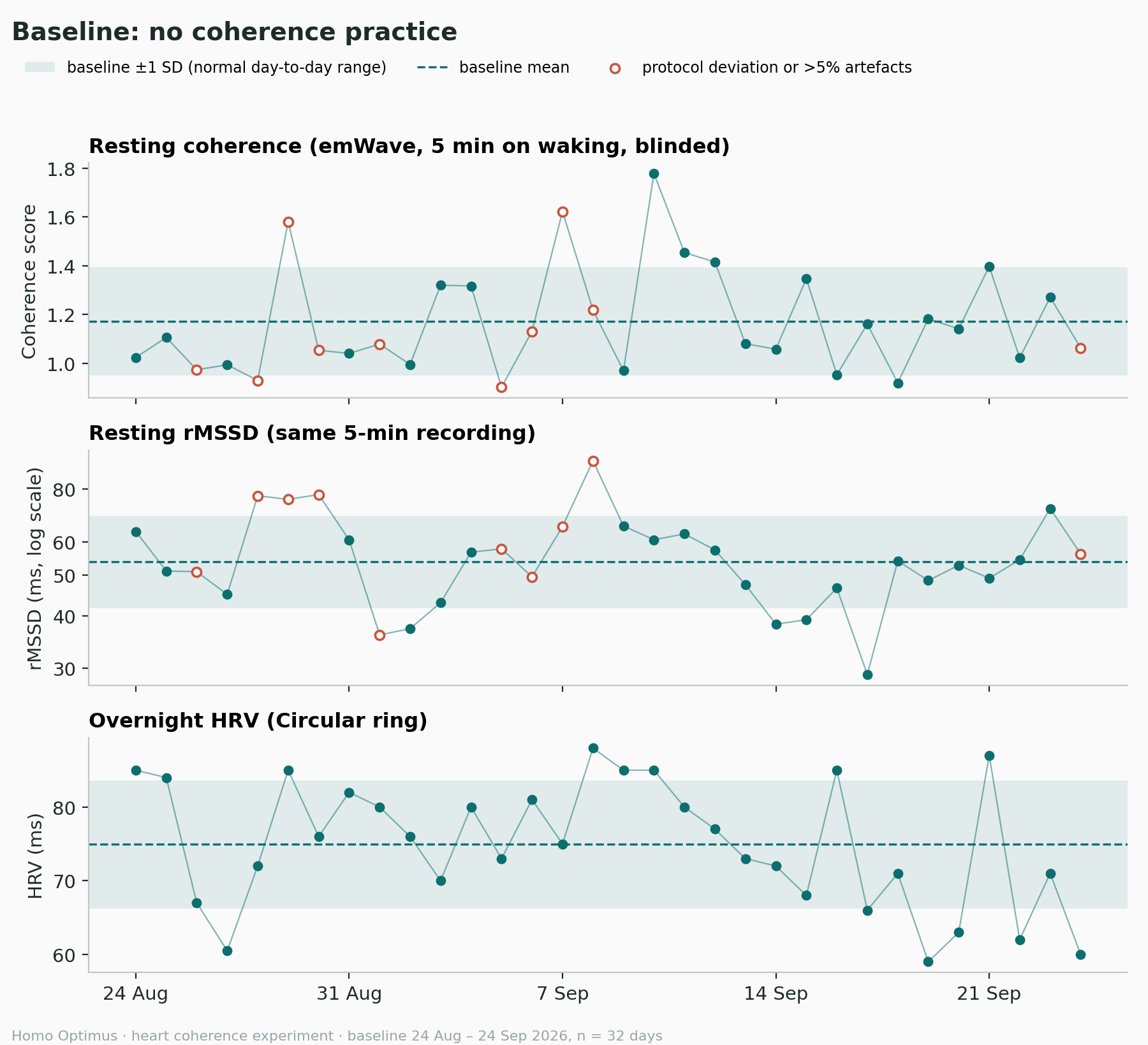
An overview of the baseline data from the 24th of August to the 24th of September.
After analysis of the baseline (24 Aug - 21 Sep), resting coherence seemed to be steadily drifting upward. This would have meant that my baseline increased on its own, just by running the measurements, and the increase was big enough to be significant. Adding the extra days (22 - 24 Sep) to the analysis showed that it was just a high week and not a trend. Before kicking off, all data will be integrated.
The experiment
During the experiment I will continue doing what I did during the preparation phase; also check my previous post, The confounders. On top of all this, I will add two five-minute coherence sessions with the emWave pro per day. A complete day will require both sessions to be logged. Why five minutes and why two sessions? I like it when a habit does not take up too much time, so five minutes should work without feeling like a chore. Two sessions is also not excessive, so I am sure I will do them daily and not forget about them when life happens. This is also the practice Rollin McCraty (PhD, director of research at the HeartMath Institute that sells the biofeedback devices) uses, as I mentioned last week in the Heart coherence publication.
When will I run the sessions?
The first session will take place in the morning, right after finishing the baseline session, measuring my BP and logging my data. My transcendental meditation will take place after this session. The second one will be run right before going to bed; the last thing I do. Since this will not be at the exact same moment every day, the time will be logged with the session. I chose these moments because it makes the sessions fit into my morning and evening routine, making it easier to turn them into a habit.
How long will I run them for?
I was initially planning on running every experiment for only one month, but it might not be enough to see clear results. That is why I have decided to run this experiment for two months, with an intermediate evaluation after one month. This evaluation is just a progress report and will have no effect on the experiment, it will keep on running. After this period I will continue testing my baseline for another month to see if my coherence reverts to baseline. Since this will be done in December, the outcome of this “withdrawal” phase could be affected by multiple other factors. It is the darkest month of the year, a holiday period, some alcohol might be involved, etc. Plenty of reasons for my routines to be disrupted. Nevertheless I will stick to them as well as I can and log everything out of the ordinary. There are three weeks before the start of the holiday period, these should not be affected as much.
During this last month I can also prepare for the next experiment. So the rest of this year will focus on heart coherence.
What will the sessions look like?
As mentioned, the sessions will take five minutes. They will be run at the lowest challenge level1. This does not influence the calculation of the average coherence score, so it is just to be coherent throughout the experiment. I will use the breath pacer in the app, which will have me breathe six breaths a minute. During the sessions I will use the device’s feedback since I will be aiming for a high average coherence.
Specific confounders
But what if I end up sick? As long as it remains possible, I will stick to the experiment. The illness will be logged and taken into account during the analysis. In case of a long interruption (two weeks or more) I will extend the experiment or restart it.
Caffeine should not be an issue. My first cup is always after my morning measurements and I stop drinking coffee in the afternoon. Any exceptions will be logged.
Alcohol will be the biggest confounder. I do not drink a lot or regularly, but it does happen. When I drink it will be logged, but the effects can last up to twenty-four hours. The analysis will take this into account.
The outcome
The experiment will look at primary and secondary outcomes. The primary ones are the ones I am aiming to improve with the experiment. The secondary ones can be considered as side effects, but they can be interesting nevertheless.
Primary outcomes:
I have defined two primary outcomes for the experiment. The average coherence score I get from my morning baseline sessions and the overnight HRV rating I get from my Circular Ring.
These are claimed to improve when practising coherence regularly, so that is what I will be testing.
Secondary outcomes:
The secondary outcomes are anything else I log that might be affected by the coherence practice. For these I will be looking at the following data:
Anything coherence related that is not the average coherence score (achievement score, coherence ratio, within-session trend, peak frequency location, practice-session scores over time versus baseline-session scores)
Sleep (total sleep time, sleep efficiency, time to fall asleep, wake episodes, stage distribution, sleep debt)
The cardiovascular system (resting HR, overnight minimum HR, day-to-day HRV variability, BP, pulse)
Respiration (overnight breathing rate, SpO2)
Subjective feelings (morning grogginess, general feel, energy and stress)
The body (weight, overnight skin temperature)
Training (perceived exertion, CAROL power output, VO2max estimate)
Success criteria and numbers:
Ideally both primary outcomes see an increase against the full six-week baseline period as mentioned above. This would make the experiment a success. If only one of the outcomes sees the desired improvement it will be considered a partial success.
If any of the secondary outcomes are positive, it can be seen as a nice to have, but they will not have an effect on the successful outcome of the experiment. All of the items on this list are exploratory. If they increase, it is an interesting sidetrack to investigate at a later moment.
The secondary outcomes could however prevent the experiment from being a success. This will be the case if any of the metrics decline by more than twice their detectable change, measured over the full intervention period. This type of decline is big enough to matter rather than be noise.
The outcome will be determined by all logged data of the whole experiment period, even days that are not complete. All data matters and even not practising can have an effect. An analysis of only complete days will be made as well.
What are the numbers I will be looking at?
With a few more days to go before my baseline period ends, these numbers might shift slightly. On the 1st of October I will report the definite numbers. The method by which they are calculated remains the same.
My baseline average for coherence currently sits at 1.17, with a standard deviation (SD) of 0.22, and for HRV at 75 ms, with an SD of 8.7 ms. These numbers will be used in two comparisons. The first one will compare these numbers against the full experiment over the months October and November. The second one will compare them against only November. The learning curve will be steeper in the beginning and it should stabilise in the second month.
For the average coherence there is a real effect if it reads over 1.26 for the whole experiment and over 1.28 for the month of November. These are 8% and 9% improvements.
For the overnight HRV there is a real effect if it reads over 79.2 ms in the first case and over 80 ms in the second. These are 6% and 7% improvements.
These values are derived from my baseline variability. This means the change during the experiment has to exceed normal day-to-day variation, calculated from the standard deviation.
Experiment structure:
The experiment is structured in an A-B-A fashion. “A” being baseline establishment and reverting to baseline and “B” being the intervention. With regards to this structure there are three possible outcomes:
Primary outcome is successful and rises during the experiment; it falls again during the withdrawal period.
Primary outcome is successful and rises during the experiment; it stays elevated during the withdrawal period.
Primary outcome does not change during the experiment; no point in having a withdrawal period.
The first option would be the strongest evidence of the effect of the practice. The second one could mean there is a lasting trait change, but it could also have to do with drift or seasonality. The final one would mean the practice has no effect (on me).
Final reminder:
Important to keep in mind that there might be a ceiling problem here. I am already trained in breathwork and meditation, so no effect does not necessarily mean these interventions do not work. They might just have no effect on my already trained state.
The levels are low, medium, high and highest.