

This week I will give an introduction on (heart) coherence1. There was already a sneak peek last week when I described my tools. Now we will take a deeper dive, without getting lost in technicalities. I am no subject matter expert either, just an enthusiast.
What is coherence?
As I mentioned last week, Heart Rate Variability (HRV) represents the variation in intervals between heartbeats. Coherence simply means a smooth, rhythmic variation. This variation can be seen on the top part of the reading in the emWave pro app. On the bottom left you will see the coherence over time with three colour-coded zones that change depending on the challenge level you use within the program. Green means you are in a coherent state and red is of course the opposite, while blue is in between. With the coherence over time your coherence score is calculated. Finally on the bottom right you have the spectrum average where you can see the average of the different frequency components of the heart rhythm.
Since a picture speaks more than a thousand words I will show you what coherence looks like.
This first print screen was taken from one of my baseline sessions with the HeartMath emWave pro. These are the sessions I have been running daily since mid-August to establish my baseline coherence before starting the experiment in October.
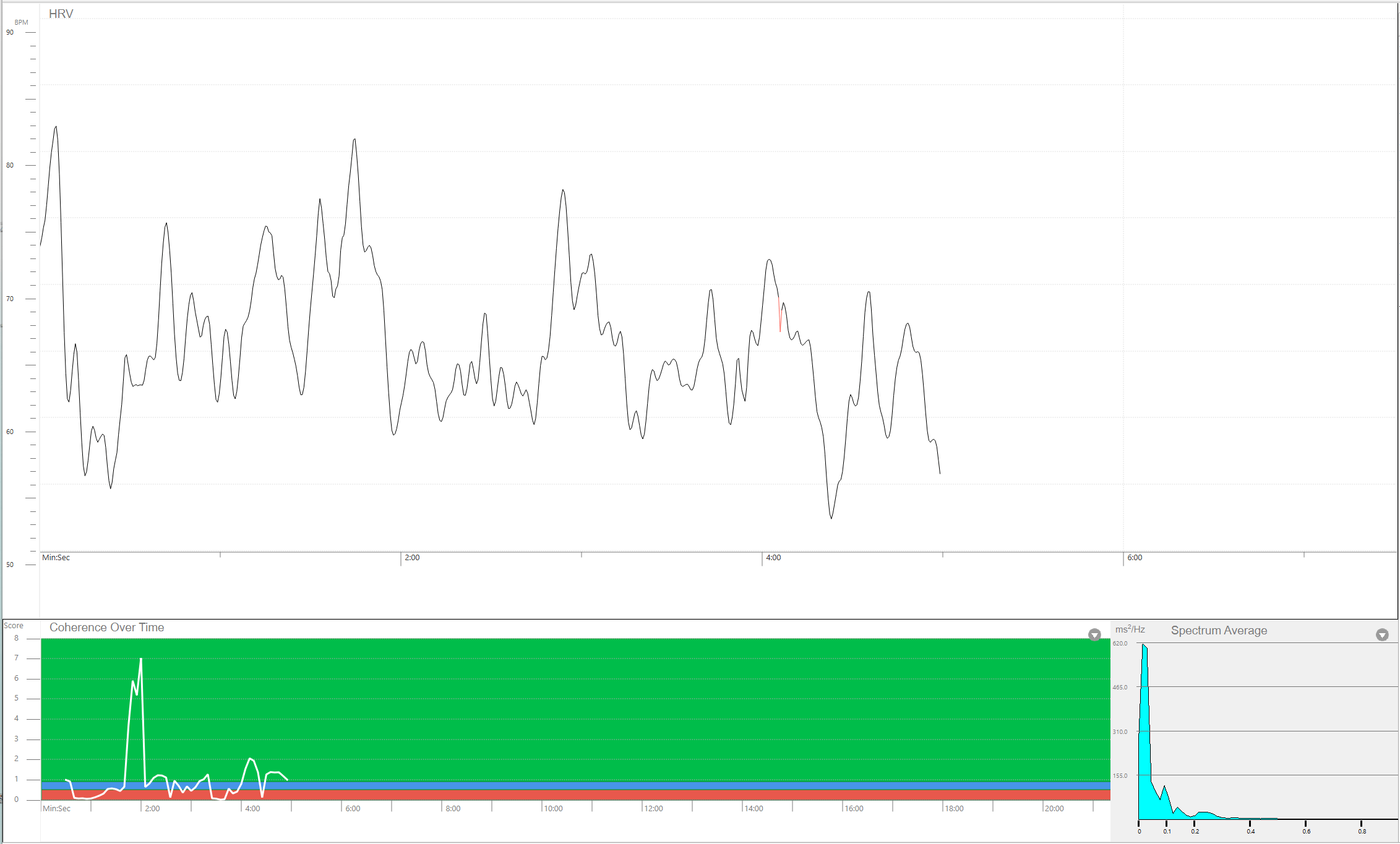
As you can see on the upper part of the reading, the line representing my heart rate (HR) over time is quite jagged and irregular. The bottom left shows my coherence over time and it is mostly in the blue (meh) and red (oh no!) zones apart from one peak in the green (good job!) zone. The bottom right shows the frequency spectrum during the measurement. Here it is between 0 and 0.5 Hz with a big peak below 0.1 Hz.
The second print screen was taken from one of my best sessions. Not a baseline session, since I do not focus on anything during those, but a focused breathing session.
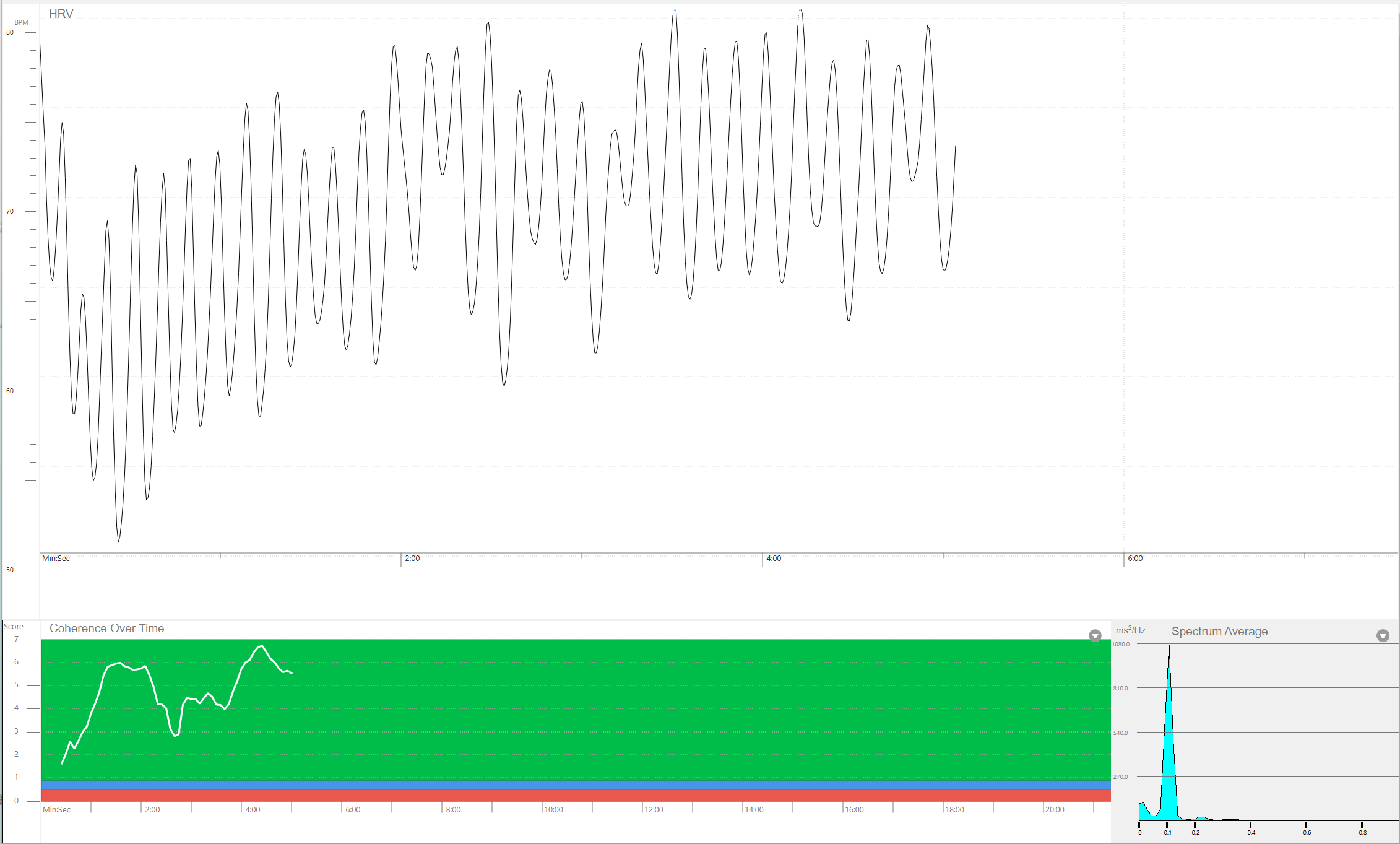
Here you can clearly see a fluent harmonious line, almost like a sine wave. My coherence over time (bottom left) is exclusively in the green (good job!) zone. On the frequency spectrum (bottom right) I have a big peak at 0.1 Hz.
How does it work and why do I want it?
Breathing plays a big part and can directly influence heart coherence. What is the mechanism behind this? I will try to explain it in an easy manner.
The heart and lungs are both connected through the vagus nerve, which is responsible for the parasympathetic nervous system. This nervous system is one part of the autonomic nervous system; the other one being the sympathetic nervous system. They are often described as the fight or flight (sympathetic) and the rest and digest (parasympathetic) systems. Through this connection, breathing can directly influence the HR.
This is where respiratory sinus arrhythmia (RSA) plays a part. Contrary to what was once thought, the heartbeat is not a stable rhythm that only changes when you become more (or less) active. Even at rest, the HR changes between every beat. As you can see on the image below:
When you breathe in (blue sine wave going up), the heart starts beating faster (orange heartbeat graph with closer intervals). Breathing in inhibits the vagal outflow to the heart, allowing the HR to go up.
When you breathe out (blue sine wave going down), the heart slows down (orange heartbeat graph with larger intervals). Breathing out resumes the vagal outflow and the HR can fall again.
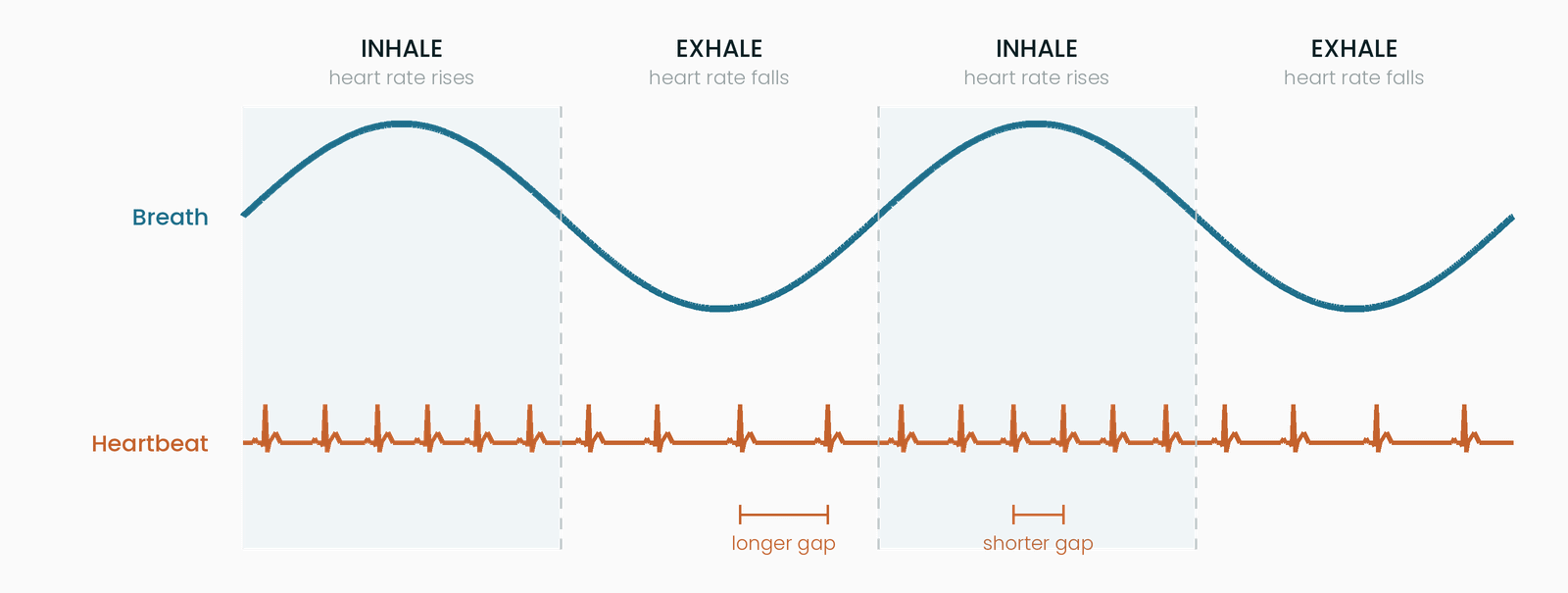
Playing around with your breath has a direct influence on this. If you breathe out for longer, the heart has more time to slow down and your HR will drop. So your breathing pattern has a direct impact on your HR.
This has a few positive effects. Instead of an automatic gearbox, it gives you a semi-automatic gearbox. You have the option to shift gears whenever you feel like it or need it. This allows you to regulate your nervous system, useful for people dealing with chronic stress, for example. It can help reduce your blood pressure (BP), useful for people with hypertension. There is also evidence that it helps improve the BP regulation system.
Practising it regularly is also claimed to help increase your HRV. This is exactly one of those claims I want to test for myself!
How do I get it?
Breathing can help to get you in a coherent state, when you focus on it. For coherence a Breathing Rate (BR) of six breaths per minute is the reference. It means you complete a full breath cycle every ten seconds. Five seconds in, five seconds out. We can link this back to the emWave pro session images I described earlier.
The second emWave graph I showed was from me doing exactly this and it gave near perfect coherence. I mentioned 0.1 Hz in the What is coherence? section; now is the time to expand a little on that topic, since it relates directly to the breathing part. One of the frequencies that plays a part for the spectrum average is the BR. In this specific case the 0.1 Hz means 0.1 breath per second, or one breath per ten seconds (the BR mentioned in the previous paragraph). Adopting this rate gets you in a state of coherence, because BP also oscillates roughly every ten seconds. When the two frequencies match they amplify each other. This is the reason why my good session had a peak at 0.1 Hz and the baseline session did not.
So will I now try to keep that BR for the rest of my life? Unlikely. Breathing is still a mostly automatic system and most of the time I will not be paying attention to it. Being coherent is easy enough when you focus on it, but can you also become more coherent when you are not paying constant attention to it?
What and why will I be testing?
This brings me to the conclusion of today’s writing. How did I end up wanting to do a test on heart coherence?
In my mind I remember hearing somewhere that practising heart coherence twice a day for five minutes does something. This is quite vague, so I made an effort to get back to the source of this.
I have listened to a fair share of episodes of The Human Upgrade podcast and in one of them Dave Asprey2 (the host) sits with Rollin McCraty (PhD, director of research at the HeartMath Institute that sells the biofeedback devices) and they talk about coherence. They talk about the benefits of coherence and Rollin McCraty then mentions that he practises twice a day for five minutes and says that (for him) it is more than enough.
The “twice a day for five minutes” stayed stuck in my head and when I got the emWave pro, I decided to start testing this for myself. Will my resting coherence and HRV improve?
The exact protocol I will use is what I will write about next week. See you then!
References:
A lot of theory about coherence is provided by the HeartMath Institute. If you go to their website https://heartmathelearning.org/, there are quite a few free courses and also some paid ones. There is a module specifically on coherence.
This is not a HeartMath commercial; I just use their biofeedback device. It is worth mentioning that HRV biofeedback has also been researched independently. You can find the research here: Lehrer PM and Gevirtz R (2014), Frontiers in Psychology, Heart rate variability biofeedback: how and why does it work?
If you are interested in the specific podcast episode where I got my idea, you can find it here: The Human Upgrade.
For this publication and future ones I will refer to the phenomenon as heart coherence or coherence. Know that other terms such as HRV coherence or cardiac coherence can also be used. Coherence on its own can mean many different things, but in the context of Homo Optimus I will use it specifically for heart coherence unless mentioned otherwise.
I like Dave Asprey, since he talks about a wide array of subjects, but I also know he is a bit controversial. Everyone is old and wise enough to believe what they want. You do not have to agree with everything he says. If you do not believe it, test it ;)